OU Trading
published at Aug 5, 2026
part of project asemb
The trading stage follows Avellaneda–Lee’s OU s-score strategy: residualize each stock’s daily return against a peer factor, model the residual as an Ornstein–Uhlenbeck (mean-reverting) process, and trade the contrarian s-score. I residualize each stock against its embedding k-NN peer basket (k = 20).
The pipeline: a 60-day trailing residual → AR(1) fit → keep only fast reverters (κ > 8.4) → s-score → bang-bang, dollar-neutral trades (enter at |s| > 1.25, exit at s = −0.5 long / +0.75 short) → 10 bps round-trip cost → walk-forward with a 45-day 13F-availability lag, so the signal is out-of-sample by construction.
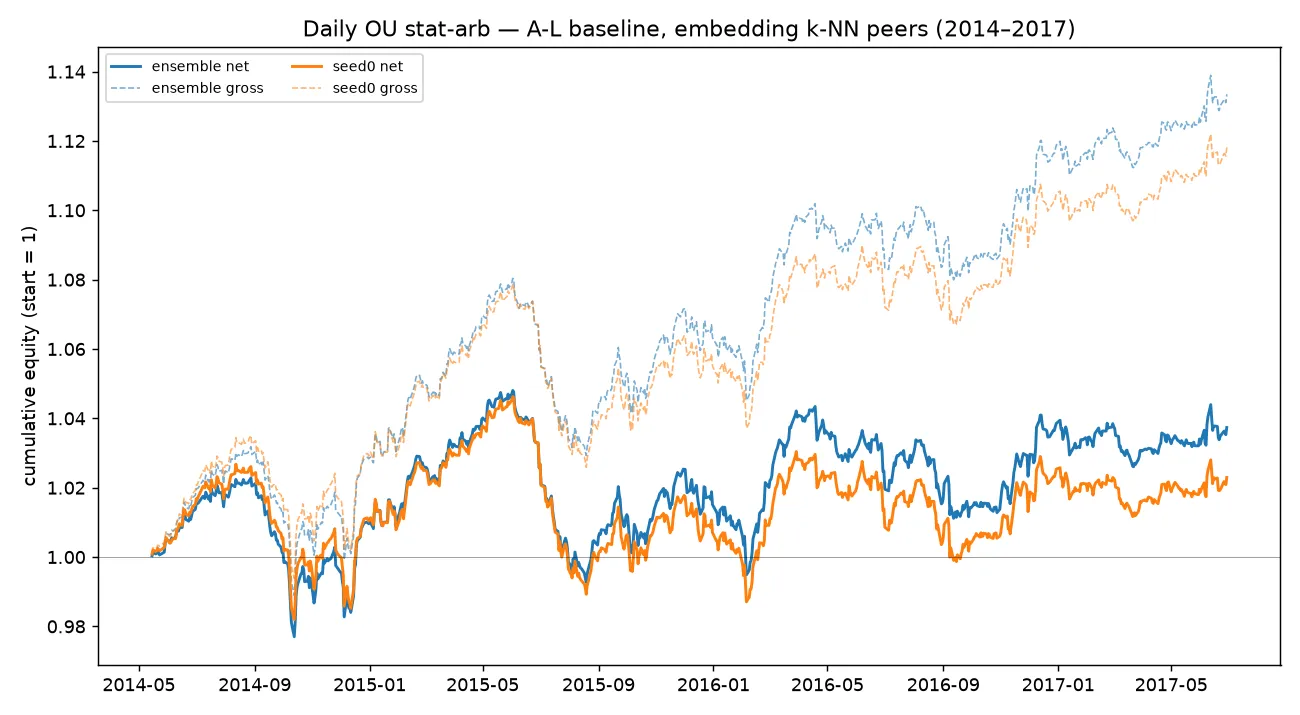
Result (2014–2017): gross Sharpe 1.24, net 0.37. Two checks confirm the signal is real: the ensemble embedding beats a single seed (1.24 vs 1.10 gross — stability translates into P&L), and a scrambled-signal control loses badly (net −11.8), so the returns aren’t a turnover artifact.
The bottleneck is turnover, not signal. Next steps target exactly that: optimal-stopping entry/exit bands (Leung–Li, Optimal Mean Reversion Trading) to replace the fixed ±1.25 / 0.5 thresholds, and an explicit cointegration test on the residual as the reversion filter.
Code: code/asemb/alg.